
Conversion Rate Optimization: Complete Guide to CRO Strategies

ManasviDigi2
October 22, 2026Attracting visitors to your website is only the first step; converting them into customers or qualified leads drives business growth. Conversion Rate Optimization (CRO) helps improve website performance by understanding user behavior and removing barriers to conversion. Businesses can combine CRO with effective digital marketing solutions to make better use of their website traffic.
Effective Conversion Rate Optimization strategies focus on improving landing pages, simplifying forms, strengthening calls to action, and creating a better user experience. These improvements help businesses turn more visitors into valuable customers.
In this guide, we’ll explore practical CRO strategies and techniques to improve website conversion rates. You’ll learn how to identify opportunities, measure results, and make data-driven decisions.
What Is Conversion Rate Optimization (CRO)?
Conversion Rate Optimization (CRO) is the process of improving a website to increase the percentage of visitors who take a desired action, such as making a purchase, submitting a form, or requesting a quote.
CRO involves analyzing user behavior, identifying barriers, and testing improvements to create a better website experience. Common techniques include A/B testing, landing page optimization, and simplifying forms.
Effective Website Conversion Optimization helps businesses convert more existing visitors into customers and achieve better marketing results.
How to Calculate Conversion Rate
Conversion rate measures the percentage of website visitors who complete a desired action, such as making a purchase or submitting a form. Calculating it helps businesses evaluate marketing performance and identify opportunities to improve conversions.
Conversion Rate Formula
Conversion Rate = (Number of Conversions ÷ Total Visitors) × 100
Conversion Rate Calculation Example
For example, if your website receives 2,000 visitors and 100 complete a purchase, your conversion rate is:
(100 ÷ 2,000) × 100 = 5%
Macro Conversions vs. Micro Conversions
- Macro conversions: Primary business goals, such as purchases or qualified lead submissions.
- Micro conversions: Smaller actions that indicate interest, such as clicking a CTA, signing up for a newsletter, or adding a product to the cart.
Tracking both helps businesses understand user behavior and improve their overall conversion strategy.
Why Is Conversion Rate Optimization Important?
Conversion Rate Optimization helps businesses improve website performance and get more from their existing traffic. When combined with a well-planned performance marketing strategy, CRO can help businesses evaluate campaign effectiveness and improve the value of their marketing spend.
- Get More Value From Existing Website Traffic: Convert more visitors into customers without relying only on increasing traffic.
- Improve User Experience and Reduce Friction: Make navigation easier, simplify forms, and remove barriers that prevent visitors from converting.
- Generate More Qualified Leads and Sales: Guide potential customers toward relevant actions with clear messaging and effective calls to action.
- Measure Marketing Performance and ROI More Effectively: Use conversion data to identify successful strategies and make informed marketing decisions.
What Is the Conversion Rate Optimization Process?
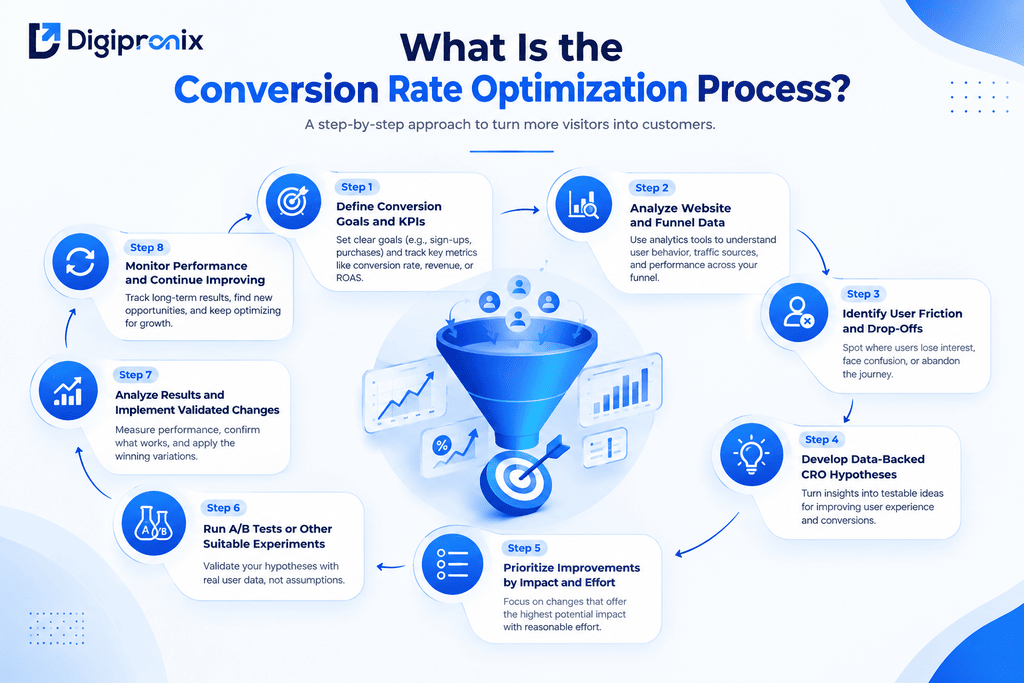
The Conversion Rate Optimization (CRO) process involves analyzing website performance, understanding visitor behavior, and testing improvements to increase conversions. Following a structured process helps businesses make informed decisions and improve results over time.
- Define Conversion Goals and KPIs: Identify desired actions, such as purchases, form submissions, or qualified leads.
- Analyze Website and Funnel Data: Use analytics to understand visitor behavior and conversion performance.
- Identify User Friction and Drop-Offs: Find issues in navigation, forms, landing pages, or checkout flows.
- Develop Data-Backed CRO Hypotheses: Suggest improvements based on user behavior and available evidence.
- Prioritize Improvements by Impact and Effort: Focus on changes with the strongest potential business value.
- Run A/B Tests or Other Suitable Experiments: Compare different versions to evaluate what works best.
- Analyze Results and Implement Validated Changes: Review outcomes and apply improvements supported by reliable evidence.
- Monitor Performance and Continue Improving: Track KPIs and repeat the process to maintain progress.
10 Conversion Rate Optimization Strategies for Better Results
Effective Conversion Rate Optimization strategies help businesses improve website usability, remove conversion barriers, and turn more visitors into customers. By understanding visitor behavior and making data-driven improvements, businesses can create better user experiences and achieve their marketing goals.
1. Match Landing Pages With Search Intent and Ad Messaging
Ensure your landing page matches what visitors expect from search results, social media campaigns, or paid ads. Understanding the differences between Google Ads and Facebook Ads can also help businesses align campaign messaging with the audience’s expectations.
2. Write Clear, Benefit-Focused Headlines and Website Copy
Your headline should communicate your main value proposition and explain how your product or service helps visitors. Use simple, relevant language that addresses customer needs and makes your offer easy to understand.
3. Create Strong Calls to Action (CTAs)
Use clear, action-oriented CTAs such as Get a Free Quote, Book a Consultation, or Get Started. Place them where visitors are most likely to make a decision, and ensure the next step is clear.
4. Simplify Lead Generation and Contact Forms
Long or complicated forms can discourage visitors from submitting their details. Ask only for the information you genuinely need, use clear field labels, and make the submission process easy on both desktop and mobile devices.
5. Improve Website Navigation and Page Structure
Organize your website content with clear menus, descriptive headings, and logical page layouts. Visitors should be able to find important information, compare options, and reach key pages without unnecessary effort.
6. Optimize Website Speed and Mobile Usability
Slow-loading pages and difficult mobile layouts can interrupt the user journey. Optimize images, reduce unnecessary scripts, improve page responsiveness, and ensure buttons and forms work smoothly across different screen sizes.
7. Build Trust With Reviews, Testimonials, and Relevant Proof
Visitors are more likely to consider a business when they can evaluate its credibility. Display genuine customer reviews, relevant testimonials, transparent pricing, contact details, and appropriate security information to help users make informed decisions.
8. Reduce Checkout and Conversion Funnel Friction
For e-commerce websites, simplify checkout steps, communicate shipping costs clearly, and offer convenient payment options. For service businesses, make enquiry forms and consultation bookings straightforward so visitors can complete their intended actions easily.
9. Use Analytics and Visitor Feedback to Understand Behavior
Tools such as Google Analytics 4 and Microsoft Clarity can help identify user journeys, page engagement, and potential drop-off points. Combine quantitative data with customer feedback to understand where visitors struggle and which improvements deserve attention.
10. Test Page Layouts, Messaging, and Offers Before Scaling Changes
Use A/B testing or other suitable experiments to compare alternative headlines, CTAs, page layouts, or offers. Define a clear hypothesis, measure the relevant conversion metric, and evaluate results carefully before implementing changes across your website.
By applying these Conversion Rate Optimization techniques consistently, businesses can identify improvement opportunities, enhance user experience, and get more value from existing website traffic. Focus on changes supported by evidence and measure their impact on meaningful outcomes, such as qualified leads, purchases, and revenue.
Best Conversion Rate Optimization Tools
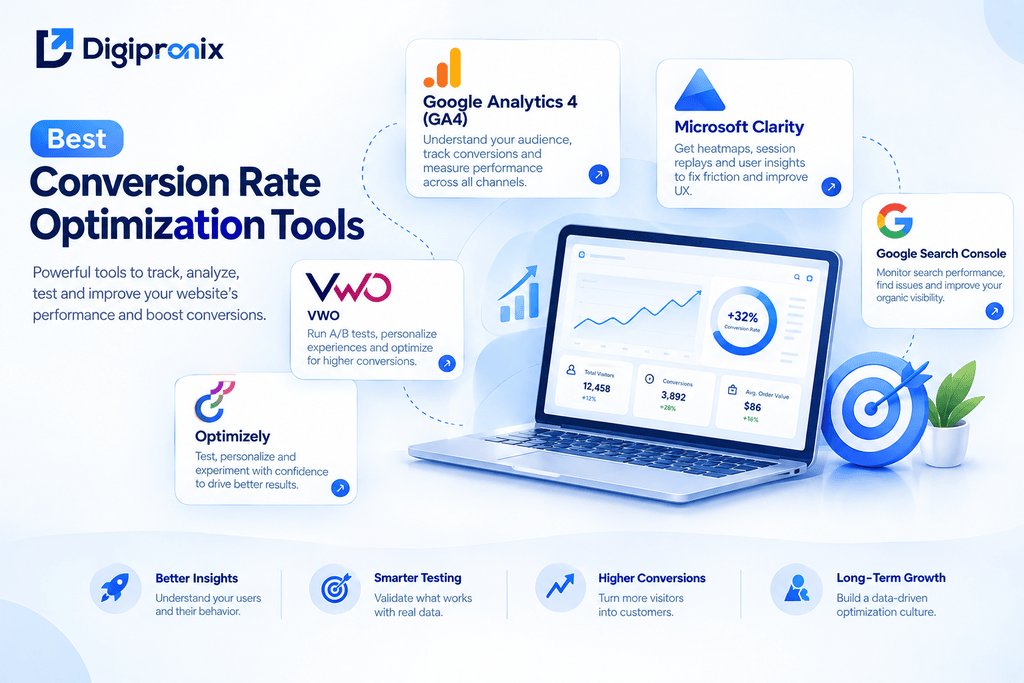
The right tools help businesses understand visitor behavior, identify conversion barriers, and improve website performance. Here are some useful tools for Conversion Rate Optimization (CRO):
- Google Analytics 4 (GA4): Track conversions, user journeys, engagement, and website performance.
- Microsoft Clarity: Analyze heatmaps and session recordings to identify potential usability issues.
- Google Search Console: Understand organic search performance and how visitors discover your website.
- VWO: Explore experimentation and A/B testing capabilities to compare website variations.
- Optimizely: Support experimentation and test different digital experiences, depending on your plan and setup.
Choose tools based on your business goals, budget, and technical requirements. Combining analytics with user behavior insights can help you make more informed Website Conversion Optimization decisions.
How to Measure CRO Success
Evaluating conversion performance alongside traffic acquisition helps businesses understand how different channels contribute to enquiries and sales. Our guide to SEO vs PPC explains the differences between paid and organic approaches to generating traffic.
- Conversion Rate: Measure the percentage of visitors who complete a desired action.
- Conversion Volume: Track purchases, form submissions, and bookings.
- Lead Quality: Evaluate whether enquiries are likely to become customers.
- Cost per Conversion: Calculate the cost of generating each conversion.
- Revenue and ROI: Assess the financial impact of optimization efforts.
- User Experience Metrics: Analyze engagement, funnel drop-offs, and visitor feedback.
Regularly comparing these metrics against a reliable baseline helps businesses identify effective CRO strategies and make informed decisions for continuous improvement.
Conclusion
Conversion Rate Optimization helps businesses turn more website visitors into customers by improving user experience, removing conversion barriers, and making data-driven decisions. From refining landing pages and CTAs to analyzing visitor behavior and testing changes, each improvement can reveal opportunities to strengthen website performance.
By applying the right CRO strategies and measuring meaningful results, businesses can better use existing traffic and support sustainable growth. Start by identifying one area of your website that needs improvement, test a suitable change, and use the results to guide your next step.