
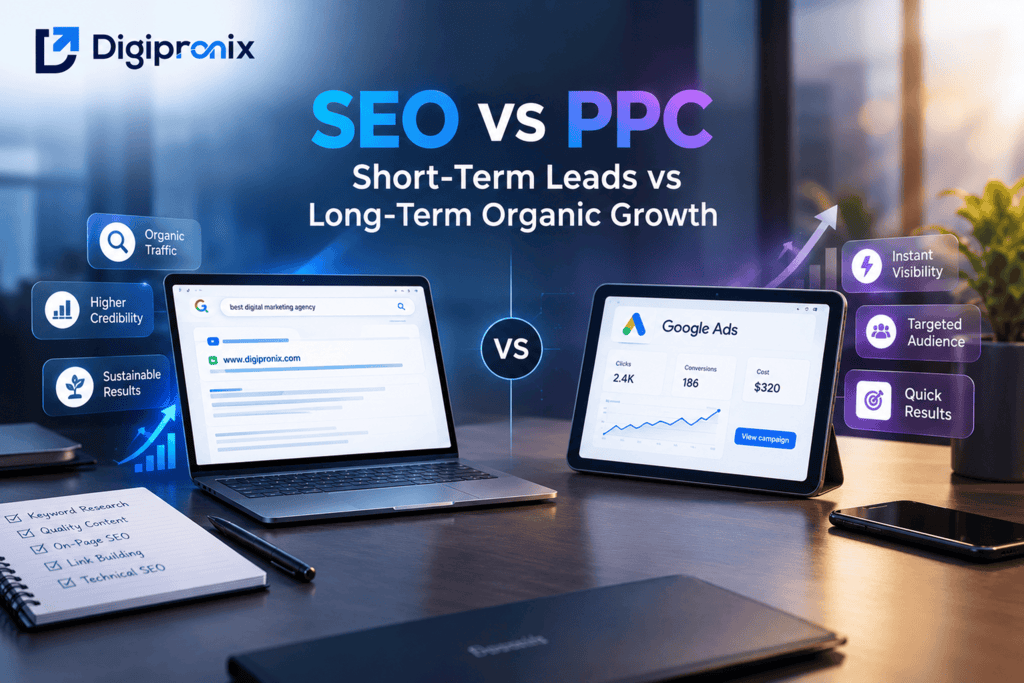
SEO vs PPC: Short-Term Leads vs Long-Term Organic Growth

digipronix
October 19, 2026Your choice between SEO and PPC depends on your company’s marketing strategy, budget, and the timeframe in which you plan to achieve your marketing goals.
Both marketing strategies have one thing in common: they can help companies increase their online visibility and attract customers. However, the two strategies differ significantly.
The main difference between SEO and PPC is that PPC can support short-term campaigns and faster lead generation, while SEO focuses on building long-term organic visibility. Understanding the benefits and ROI of SEO vs paid advertising can help businesses make informed marketing decisions.
In this guide, we will explore the differences and similarities between SEO and PPC marketing strategies.
What Is SEO?
Search engine optimization (SEO) refers to the optimization of a site’s appearance in organic search results. The process involves keyword research, useful content, optimization, internal links, and user experience optimization.
The objective of SEO is to bring in relevant people who can later turn into customers. Different from pay-per-click, SEO does not involve paying for every single click. Businesses targeting local customers can also explore Google Maps SEO to understand how to improve their visibility in local search results.
What Is PPC?
Pay-per-click (PPC) is an online advertising approach where businesses usually pay each time their ad is clicked by someone. Businesses can reach potential customers with the help of platforms such as Google Ads.
Businesses can also compare Google Ads vs Facebook Ads to understand which advertising platform better suits their target audience and campaign objectives.
One of the key PPC advertising benefits is the ability to gain visibility and attract traffic soon after a campaign goes live, provided it has the right targeting, sufficient budget, and effective optimization. The main difference between SEO vs PPC is that SEO earns organic visibility, whereas PPC uses paid placements. Both strategies can support lead generation in different ways.
SEO vs PPC: Key Differences
SEO (Search Engine Optimization) and PPC (Pay-Per-Click advertising) help businesses attract visitors from search engines, but they differ in how visibility is earned, how costs work, and how results develop over time.
| Comparison factor | SEO | PPC |
|---|---|---|
| How it works | Improves visibility in organic search results through relevant content, technical optimization, and authority building. | Uses paid advertising campaigns to display ads for relevant searches and audiences. |
| Search visibility | Earns organic placements based on search engine ranking systems. | Competes for sponsored placements through an advertising auction. |
| Time to results | Usually takes time to build rankings and consistent organic traffic. | Can generate visibility and traffic soon after campaigns are approved and active. |
| Cost structure | Requires investment in content, optimization, technical improvements, and ongoing SEO work. | Generally charges per click in PPC campaigns, with costs influenced by bids, competition, and campaign settings. |
| Lead generation | Can attract potential customers through relevant informational and commercial searches over time. | Can target high-intent searches and generate leads when ads and landing pages perform well. |
| Long-term value | Well-performing pages can continue attracting organic traffic, although rankings require maintenance. | Visibility typically depends on campaigns continuing to run and having sufficient budget. |
| Targeting and control | Influences visibility through content, keyword targeting, technical improvements, and user experience, but rankings cannot be guaranteed. | Offers direct controls for budgets, bidding, ad messaging, and available audience or location targeting. |
| Performance measurement | Tracks organic traffic, rankings, conversions, leads, and revenue attributed to organic search. | Tracks impressions, clicks, cost per click, conversions, cost per lead, and campaign revenue. |
| Best suited for | Building organic visibility, topical authority, and sustainable traffic. | Promoting offers, testing demand, and pursuing leads within a defined budget and timeframe. |
SEO vs PPC: Short-Term Results vs Long-Term Growth
PPC for Faster Results: PPC campaigns can start generating traffic soon after launch, making them useful for quick promotions, targeted leads, and time-sensitive offers. However, traffic generally depends on continued ad spend.
SEO for Long-Term Growth: SEO takes time to build organic visibility, but well-optimized pages can attract relevant traffic over an extended period. Consistent optimization helps strengthen search presence and support sustainable growth.
The best approach? Use PPC to pursue immediate opportunities while investing in SEO to build long-term organic visibility. The right balance depends on your goals, budget, and competition.
SEO vs PPC: Cost, Lead Quality and ROI
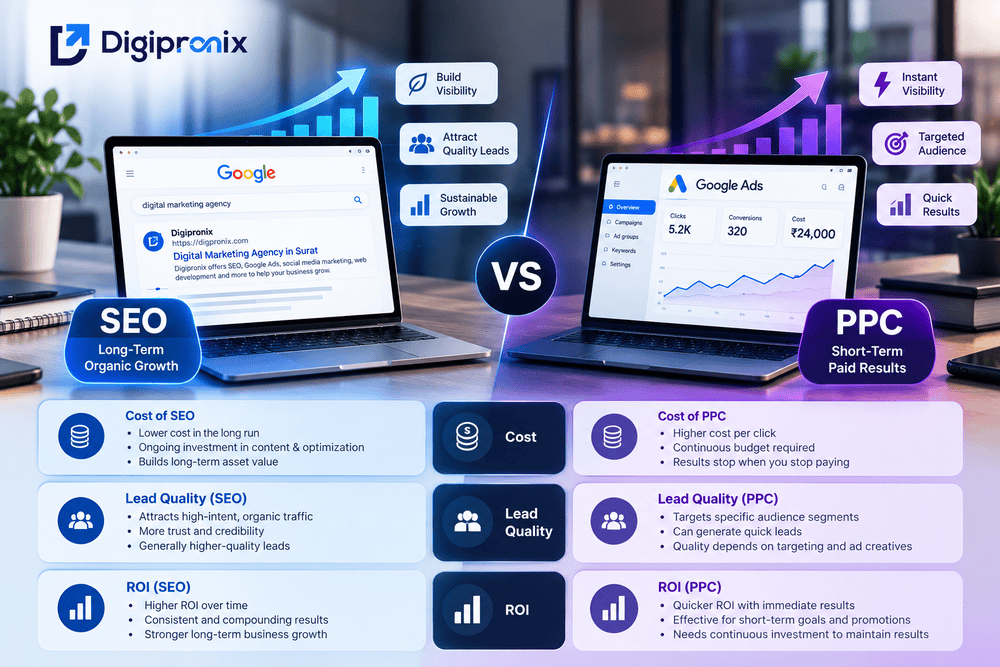
The cost and return on investment (ROI) of SEO vs PPC depend on your industry, competition, conversion rates, and business goals. SEO builds organic visibility over time, while PPC helps businesses reach potential customers through paid campaigns. However, the best strategy is not always the one that brings the cheapest traffic, but the one that generates valuable leads.
Cost of SEO vs PPC
SEO requires ongoing work to build organic visibility and attract relevant traffic. Businesses looking to improve their search rankings can explore our SEO services to support their long-term organic growth. While results take time, well-optimized pages can continue attracting organic visitors over an extended period.
PPC requires an advertising budget, campaign management, and regular optimization. Businesses generally pay for each click, and costs can vary depending on keyword competition, targeting, and industry.
Lead Quality: SEO vs PPC
When it comes to attracting quality leads, both strategies may be beneficial for businesses but in different ways. SEO allows companies to appear in search results in front of the targeted audience depending on the query, location, and other factors.
Thus, the search intent can vary from informational to transactional, suggesting that businesses are likely to benefit from such visitors in different ways. At the same time, with proper targeting, PPC advertisements also have the ability to attract quality leads with a clear intention to purchase. However, a business should also consider the conversion rates and ROI when choosing the lead quality offered by these two options.
Which Offers Better ROI?
For businesses, SEO and PPC options are the best choices for attracting new clients and increasing sales. The ROI of the discussed strategies depends on the company’s objectives, as both options offer sustainable results in the long run and short-term growth, respectively.
Therefore, organizations should consider their initial goals and choose the one that fits them better. However, in most cases, a combination of SEO and PPC services offers the best cooperation for a business developing its online presence.
As for ROI, it should be calculated based on the number of leads, conversion rates, customer acquisition costs, and money earned per sale. To connect campaign performance with broader business objectives, explore our guide to building a performance marketing strategy.
How SEO and PPC Work Better Together
Combining SEO and PPC helps businesses balance immediate visibility with long-term growth. PPC attracts targeted traffic quickly, while SEO builds organic visibility over time.
Both strategies complement each other in several ways:
- Keyword insights: Use PPC campaign data to identify valuable keywords for SEO.
- Faster visibility: PPC can attract potential customers while organic rankings develop.
- Better remarketing: Reconnect with eligible website visitors through PPC campaigns.
- Improved ROI: Track conversions, qualified leads, and revenue to optimize both strategies.
Rather than treating PPC vs SEO as an either-or decision, businesses can use both strategies to reach potential customers at different stages of the buying journey. PPC supports faster visibility, while SEO builds organic traffic over time. Together, they can help improve marketing efficiency and support sustainable business growth.
Conclusion
SEO vs PPC is not about choosing one strategy over the other; it is about finding the right balance for your business goals. SEO helps build long-term organic visibility, while PPC supports faster traffic, targeted lead generation, and campaign testing.
Combining both strategies can help businesses pursue immediate opportunities while developing sustainable organic growth. The key is to measure performance through qualified leads, conversions, and ROI rather than traffic alone.
At Digipronix, we help businesses develop tailored digital marketing strategies that align with their goals, budget, and growth plans. Whether you want to improve organic rankings or run targeted paid campaigns, the right approach can turn online visibility into measurable business growth.