
AI SEO: How to Optimize Your Website for AI Search & Rankings

digipronix
November 16, 2026Searching for something on Google or any other search engine is not just limited to having your website featured on its first page. There are many times when people turn to artificial intelligence (AI) enabled platforms and ask for suggestions, explanations, comparisons, or a solution to a problem, and the answer could include information obtained from various websites.
For businesses, this raises the question of how to ensure their website shows up in the search results provided by AI algorithms.
AI SEO, therefore, combines traditional SEO techniques with content that makes sense to both search engines and AI algorithms. A strong digital marketing strategy can help bring these efforts together.
What Is AI SEO?
AI search engine optimization involves optimizing a website so AI-enabled search systems can find, interpret, and use its content in their results.
This optimization technique differs from normal SEO in that it centers around having clear content, search intent, conversational searches, E-E-A-T, internal links, topical authority, and structured data. These fundamentals also form an important part of effective SEO services.
AI SEO is directly associated with AEO, GEO, and LLM SEO. While the terminology differs, the goal is similar: make valuable information easier for modern search and AI systems to understand.
How AI Search Is Changing SEO
While traditional search typically provides users with pages to browse, AI-powered search can help obtain information from various sources and give an actual, conversational answer. Thus, AI is changing the way websites can become visible.
The popularity of zero-click searches is growing since users may receive needed information without visiting any websites. At the same time, chatbots like ChatGPT, Gemini, and Perplexity are becoming new means for obtaining information about products and businesses.
The use of AI technology has also helped speed up content production, hence more content being created online. Therefore, originality of experience, accuracy of information, and E-E-A-T are becoming very significant.
At last, search itself is becoming more conversational, which means that users can ask complicated questions, compare the options, and continue with further queries. Consequently, SEO should go beyond keywords and create meaningful content that answers actual customer questions and reflects your expertise.
Where Your Website Can Appear in AI Search
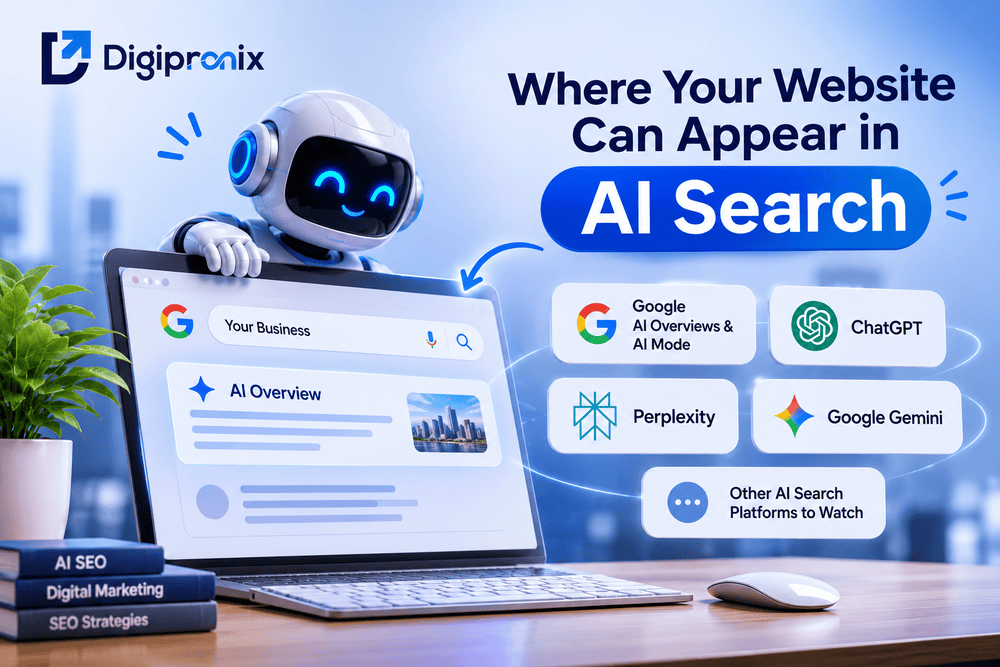
AI search is not limited to one platform. Your website can potentially become a source of information across several AI-powered experiences.
Google AI Overviews & AI Mode
Google’s AI-powered search experiences can provide synthesized answers alongside search results and link users to supporting sources. For a website to be considered, the page still needs to meet Google’s normal Search eligibility requirements.
ChatGPT
ChatGPT can provide web-based answers and cite online sources when web search is available. This creates another opportunity for businesses whose websites contain clear, useful, and trustworthy information.
Perplexity
Perplexity is strongly focused on answering questions with web sources and citations. This makes source quality, relevance, and clearly presented information particularly important.
Google Gemini
Gemini can also use web information in relevant experiences. Businesses should therefore think beyond a single search engine and build content that remains useful across different AI discovery environments.
Other AI Search Platforms to Watch
The AI search ecosystem continues to develop, so businesses should avoid building their entire strategy around one platform. The more sustainable approach is to create accessible, useful, authoritative content that can support visibility across multiple search experiences. Current industry research also shows that different AI platforms can retrieve and cite different sources, so visibility in one platform does not automatically guarantee visibility in another.
How to Optimize Your Website for AI Search
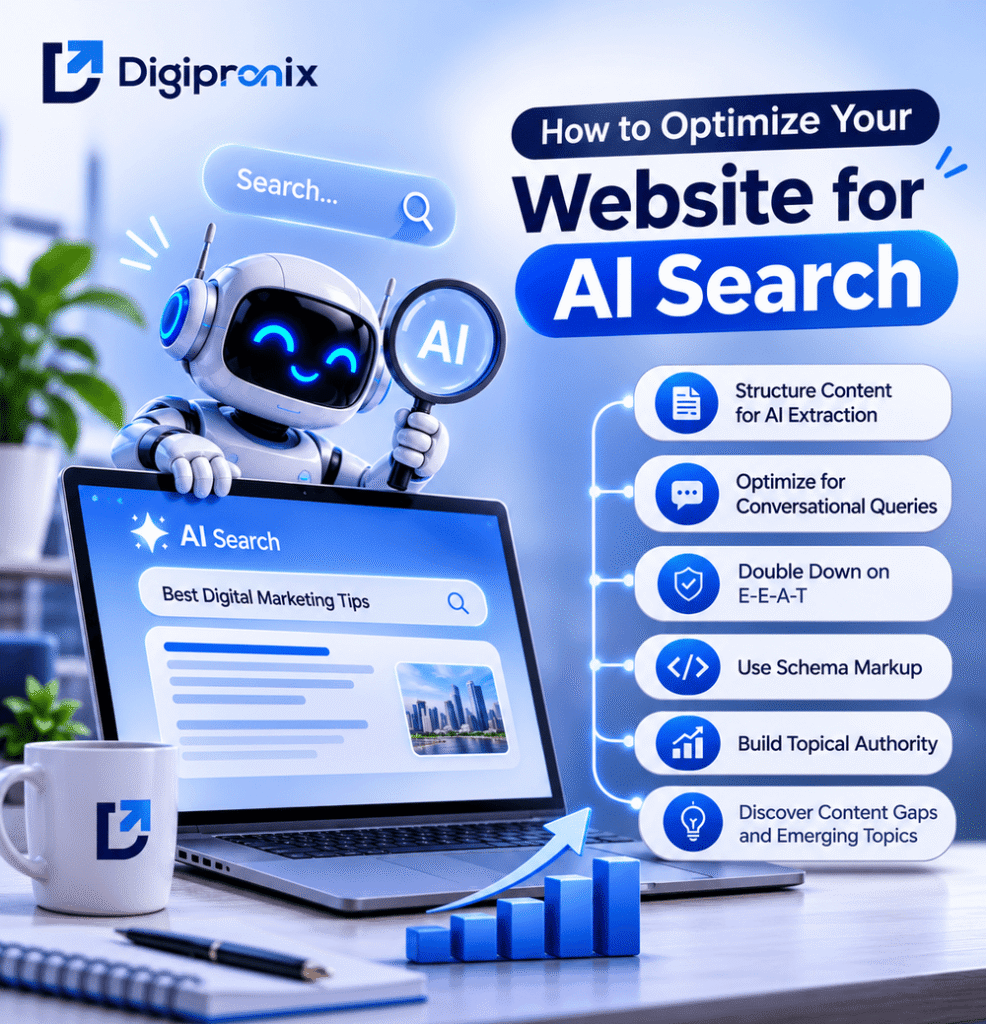
There is no single technique that guarantees an AI citation. The goal is to make your website easy to understand, useful, trustworthy, and accessible to both users and search systems.
Structure Content for AI Extraction
Use headings, short paragraphs, lists, and direct answers to structure your content. This way, you’ll help AI algorithms find and analyze the most relevant data on your page.
Keep answers to the questions you want to answer near the questions themselves. Simple and structured content will also be easier to read by visitors. A technically sound website also makes it easier for search systems to access and understand important information, making web development an important part of the overall process.
Optimize for Conversational Queries
The queries through AI platforms become more and more conversational and detailed. Make sure that your content answers all questions of your customers.
For instance, do not concentrate only on the term “AI SEO.” Instead, try to write about how you can optimize your website for AI search. Avoid inserting unnecessary keywords in all parts of your text.
Double Down on E-E-A-T
Show Experience, Expertise, Authoritativeness, and Trustworthiness through original insights, accurate information, practical examples, and credible references.
Clearly explain who you are, what you offer, and the experience behind your services. Specific evidence helps build more trust than broad promotional claims.
Use Schema Markup
Structured data helps search engines understand what your page represents and how different information relates to each other. Use relevant schema based on the type of content or business.
Common examples include Organization, LocalBusiness, WebPage, Article, BreadcrumbList, and FAQPage. Schema can support better understanding but does not guarantee rankings or AI citations.
Build Topical Authority
Cover important topics related to your main subject instead of relying on a single article. Connect relevant pages through natural internal links to create stronger topic relationships.
For example, your AI SEO content can link to SEO Cost in India and Google Maps SEO when those topics are relevant. Focus on useful coverage rather than publishing content simply to increase volume.
Discover Content Gaps and Emerging Topics
AI tools can help identify related questions, content gaps, search intent, and emerging topics. This can make SEO research faster and uncover areas competitors may not have covered well.
However, AI suggestions should be treated as research input. Verify important information and add your own experience and insights before turning an idea into published content.
There is no single trick that guarantees an AI citation. Instead, focus on making your website easy to access, understand, trust, and reference.
How to Rank in Google AI Overviews
If you’re wondering how to rank in AI Overviews, there is no guaranteed formula for getting featured. Google recommends focusing on the same core Search fundamentals that help pages become eligible for its AI-powered search features.
Start with content that clearly satisfies the searcher’s intent.
Make sure important pages are:
- Crawlable and indexable
- Helpful and relevant to the query
- Clearly structured
- Supported by accurate information
- Easy to understand
- Connected to related content through internal links
The answer to the primary question comes first, followed by the explanation.
One more thing that you should be aware of when it comes to AI is that the AI search engine results might be variable. What works for AI Overview today may not work tomorrow because of the constant changes in the search results.
How to Use AI for SEO
AI can make several SEO tasks faster without replacing strategic decision-making.
You can use AI for SEO to:
- Generate initial keyword clusters
- Group search queries by intent
- Find related questions
- Identify content gaps
- Create content briefs
- Suggest internal-link opportunities
- Review existing content
- Analyze large amounts of SEO data
The important part is what happens after the AI produces its output.
Check facts. Compare sources. Add original examples. Remove generic statements. Make sure the final content reflects genuine expertise.
AI should help your SEO team work more efficiently, not become a substitute for experience and editorial judgment.
AI SEO Checklist
Before publishing or updating a page, check:
- Is the page crawlable and indexable?
- Does it clearly answer the user’s main question?
- Are headings descriptive and logically organized?
- Is important information easy to find?
- Does the content demonstrate genuine expertise?
- Are factual claims accurate and supported where appropriate?
- Are relevant internal links included?
- Is appropriate schema markup implemented?
- Does the website have strong topical coverage?
- Have you reviewed the page for AI-search visibility as well as traditional rankings?
Conclusion
AI SEO is not about ditching SEO all together and jumping on board every available AI platform.
The better strategy is that of creating a website that can be accessed, understood, trusted, and referred to by the search engines and AI systems.
The emphasis should be made on valuable content, clear answers, technical accessibility, E-E-A-T, structure, topical authority, and real user intent. Then leverage AI for research and SEO work process optimization while maintaining the human element at the core.
In the course of the development of AI search, it will be the websites providing credible, useful, clear, and experience-based information that will be more grounded.