
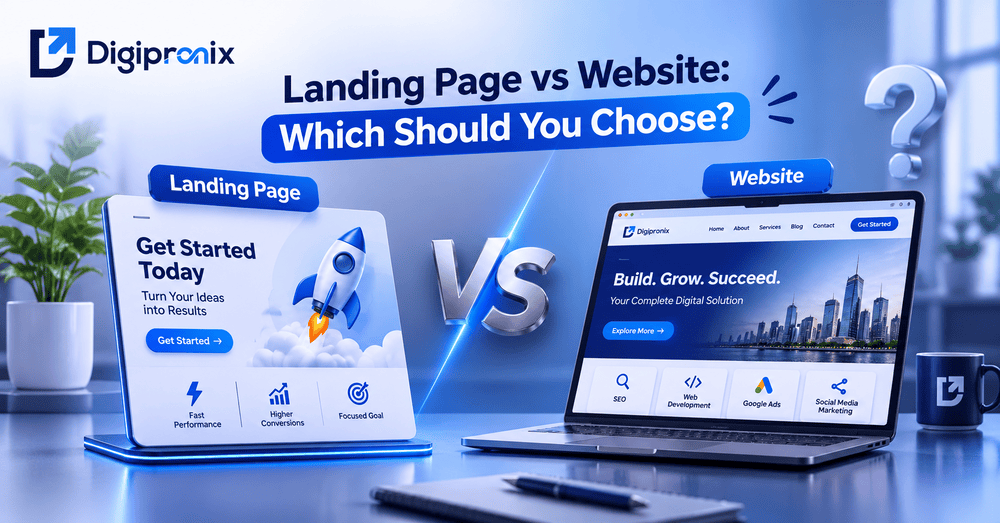
Landing Page vs Website: Which Should You Choose?

digipronix
November 20, 2026Building an online presence is important for businesses looking to reach potential customers and grow their brand.
Whether you need a focused landing page or a complete website, choosing the right approach depends on your business goals, marketing strategy, and customer needs.
Professional web development services can help create a website that supports your business objectives.
Although both help businesses establish an online presence, they serve different purposes. Understanding the difference between a landing page and a website can help you choose the right approach for attracting visitors and generating leads.
So, what is a landing page, and how is it different from a business website? Let’s explore their key differences, benefits, and uses to understand which option is right for your business.
What Is a Landing Page?
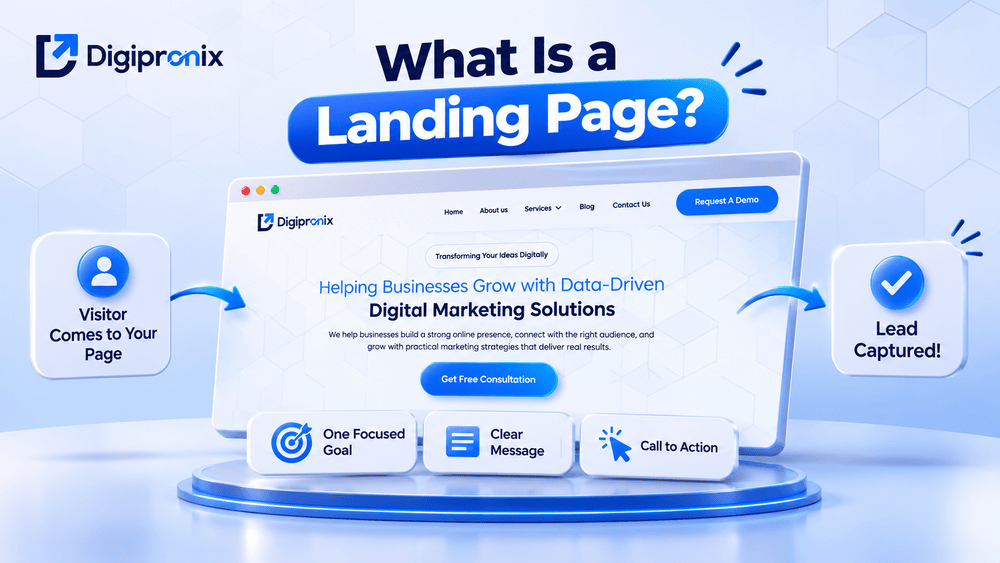
A landing page is a standalone web page created to achieve a specific marketing goal, such as generating leads, promoting a product, collecting enquiries, or encouraging purchases.
Visitors usually reach it through Google Ads, social media campaigns, email links, or other promotional channels.
Unlike a complete website, a landing page focuses on one primary objective and guides visitors towards a specific action through a clear call-to-action (CTA).
Its simple layout, engaging content, and focused message support conversion optimization by reducing distractions and encouraging visitors to take action.
Key elements of a landing page include:
- Clear headline: Communicates the main offer or purpose.
- Engaging content: Highlights the benefits of a product or service.
- Visual elements: Use relevant images, videos, or graphics.
- Call-to-action (CTA): Encourages visitors to take the desired action.
- Trust signals: Includes customer reviews, testimonials, and credibility indicators.
What Is a Business Website?
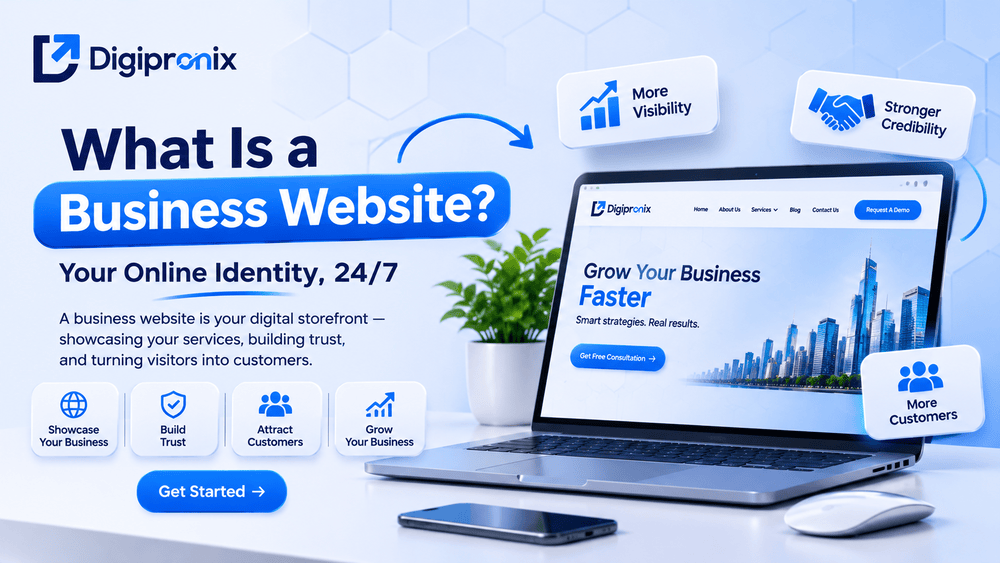
A business website is a collection of interconnected web pages available under a single domain name.
It acts as a central online platform where visitors can learn about a company, explore its products or services, understand its brand, and get in touch.
Unlike a landing page, a business website provides broader information and allows visitors to navigate between different sections.
It helps businesses establish online credibility, build customer trust, showcase their offerings, and support advanced web application development requirements.
Common pages of a business website include:
- Homepage: Introduces the business and provides an overview of its offerings.
- About Us: Shares the company’s background, values, and experience.
- Services or Products: Explains what the business offers.
- Blog: Publishes useful information, updates, and industry insights.
- Contact Us: Provides contact details, enquiry forms, and business information.
- Testimonials: Showcases customer feedback and experiences.
A well-structured business website makes it easier for visitors to explore information and understand what a company offers.
This is why choosing between a landing page vs website depends on your business objectives, audience, and marketing requirements.
Landing Page vs Website: Key Differences
Although both landing pages and websites help businesses build an online presence, their purposes, structures, and functionality are different.
A landing page focuses on encouraging visitors to complete a specific action, while a website provides broader information about a business and its offerings.
Understanding the difference between landing page and website can help you choose the right platform based on your marketing goals, audience, and business requirements.
1. Purpose and Goals
A landing page is designed around one primary objective, such as generating leads, collecting enquiries, promoting a product, or increasing sales. Its content and design encourage visitors to take a specific action through a clear call-to-action (CTA).
A business website serves multiple purposes, including introducing the company, showcasing services, sharing useful information, and building customer trust. It provides visitors with different ways to explore the business and interact with its offerings.
2. Design and Navigation
Landing pages generally use a simple, focused design with minimal navigation. They avoid unnecessary links and distractions so visitors can concentrate on the main offer and complete the desired action.
Websites have a more detailed structure with navigation menus, multiple pages, buttons, and internal links. This allows visitors to explore different sections, find relevant information, and understand the business at their own pace.
3. Content and Structure
Landing page content is usually short, persuasive, and focused on a particular product, service, or offer. It includes relevant headlines, benefits, visuals, testimonials, and CTAs to encourage conversions.
A website contains more comprehensive content distributed across different pages, such as Home, About Us, Services, Products, Blog, and Contact Us. This structure helps businesses communicate their brand message and provide detailed information.
4. Audience and Traffic Sources
Landing pages generally target a specific audience coming from Google Ads, social media promotions, email campaigns, or other marketing activities. Their messaging is tailored to match the campaign and encourage visitors to take action.
Websites attract a broader audience through organic search, direct visits, referrals, social media, and paid advertising, including campaigns planned using Google Ads vs Facebook Ads. They help businesses reach potential customers who want to explore their brand, products, or services.
5. SEO and Search Visibility
Landing pages can be optimized for specific keywords, but their limited content and single-page structure may provide fewer opportunities to target multiple search queries. They are often designed to support targeted advertising campaigns and conversions.
Websites offer more opportunities for SEO through multiple service pages, blog articles, internal links, and keyword-focused content. A well-optimized website with proper on-page SEO can attract organic traffic from different search queries and improve long-term search visibility.
6. Conversion Goals and Performance
Landing pages primarily measure performance through conversion-related metrics, such as form submissions, sign-ups, enquiries, downloads, and purchases. Their success depends on how effectively they turn visitors into leads or customers.
Websites track broader performance metrics, including organic traffic, page views, engagement, returning visitors, enquiries, and sales. These measurements help businesses understand overall website performance and customer behaviour.
Landing Page vs Homepage: What’s the Difference?
| Comparison | Landing Page | Homepage |
|---|---|---|
| Main Purpose | Encourages visitors to take a specific action | Introduces the business and its offerings |
| Customer Behaviour | Guides visitors towards one conversion goal | Allows visitors to explore different sections |
| Navigation | Minimal navigation to reduce distractions | Includes menus and internal links |
| Content | Focuses on one service, product, or offer | Provides an overview of the business |
| CTA | Usually has one primary call-to-action | May include multiple CTAs |
| Traffic Sources | Often receives traffic from ads and campaigns | Attracts organic, direct, referral, and paid traffic |
| Best For | Lead generation and conversions | Brand awareness and customer exploration |
When Should You Choose a Landing Page vs a Website?
Choosing between a landing page and a website depends on your business goals, target audience, and marketing requirements.
Both serve different purposes, so understanding when to use each can help you make the right decision.
When Should You Choose a Website?
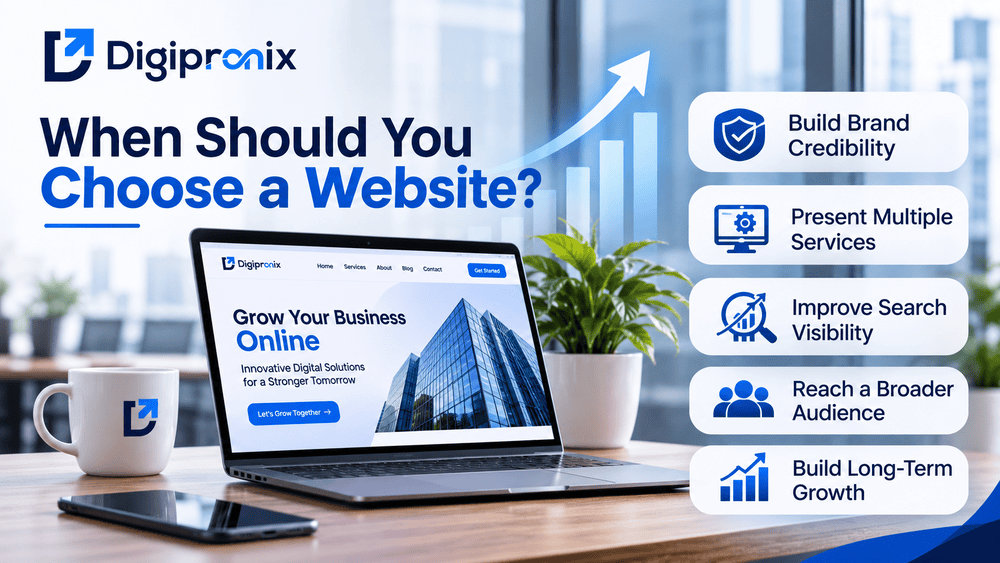
A business website is suitable when you want to establish a professional online presence and provide complete information about your company.
It helps visitors explore your services, understand your brand, and contact your business.
Choose a website when you want to:
- Build brand credibility: Showcase your business, experience, services, and customer testimonials.
- Present multiple services: Provide dedicated pages for different products, services, and business offerings.
- Improve search visibility: Target relevant keywords through service pages, blogs, and other website content.
- Reach a broader audience: Attract visitors through organic search, social media, referrals, and other channels.
- Build long-term growth: Create a central online platform and understand strategies such as SEO vs PPC to support your marketing activities.
When Should You Choose a Landing Page?

A landing page is a better choice when you have a specific marketing objective and want visitors to take one particular action.
It keeps the message focused and reduces distractions, making it useful for lead generation and campaign-based promotions.
Choose a landing page when you want to:
- Generate leads: Collect potential customers’ details through enquiry forms.
- Promote a specific service: Highlight one service, product, or special offer.
- Run paid campaigns: Use performance marketing strategies to direct relevant Google Ads or social media traffic to a dedicated landing page.
- Increase conversions: Use clear headlines, focused content, and strong calls-to-action.
- Promote limited-time offers: Encourage visitors to register, book a consultation, or make a purchase.
Can You Use Both a Landing Page and a Website?
Yes. In fact, many businesses benefit from using both. A website builds brand awareness, credibility, and organic search visibility, while dedicated landing pages support specific campaigns and conversion goals.
For example, a digital marketing company can use its website to showcase all its services and create a separate landing page for a Google Ads campaign promoting SEO services.
This approach helps businesses serve different audience needs while supporting their overall marketing strategy.
Can a Landing Page Replace a Website?
A landing page can work for businesses promoting a single product, service, or offer. However, it cannot fully replace a business website when you need to showcase multiple services, share company information, and build long-term online credibility.
A website provides a complete online presence, while a landing page focuses on a specific conversion goal. Using both together can help businesses build brand trust, attract visitors, and generate leads.
Conclusion
Choosing between a landing page vs website depends on your business goals and marketing needs. A landing page is ideal for focused campaigns and lead generation, while a business website helps build brand credibility, showcase services, and improve online visibility.
For long-term business growth, having a well-structured website supported by dedicated landing pages can be an effective approach.
At Digipronix, we help businesses strengthen their online presence through professional web development and digital marketing solutions that attract the right audience and generate enquiries.